





Skin
Acne Scarring
The treatment for pitted scarring, because it reaches the depth the scar sits at.
Explore skin
Care starts with your skin, not a treatment name.
Explore injectables
A medical consultation and an individual approach.
Explore face & body
Explore options for contour, muscle and firmness.
Explore concerns
You do not need to know the treatment. Tell us your concern.

Explore skin
Care starts with your skin, not a treatment name.
Explore injectables
A medical consultation and an individual approach.
Explore face & body
Explore options for contour, muscle and firmness.
Explore concerns
You do not need to know the treatment. Tell us your concern.

The strongest resurfacing we offer
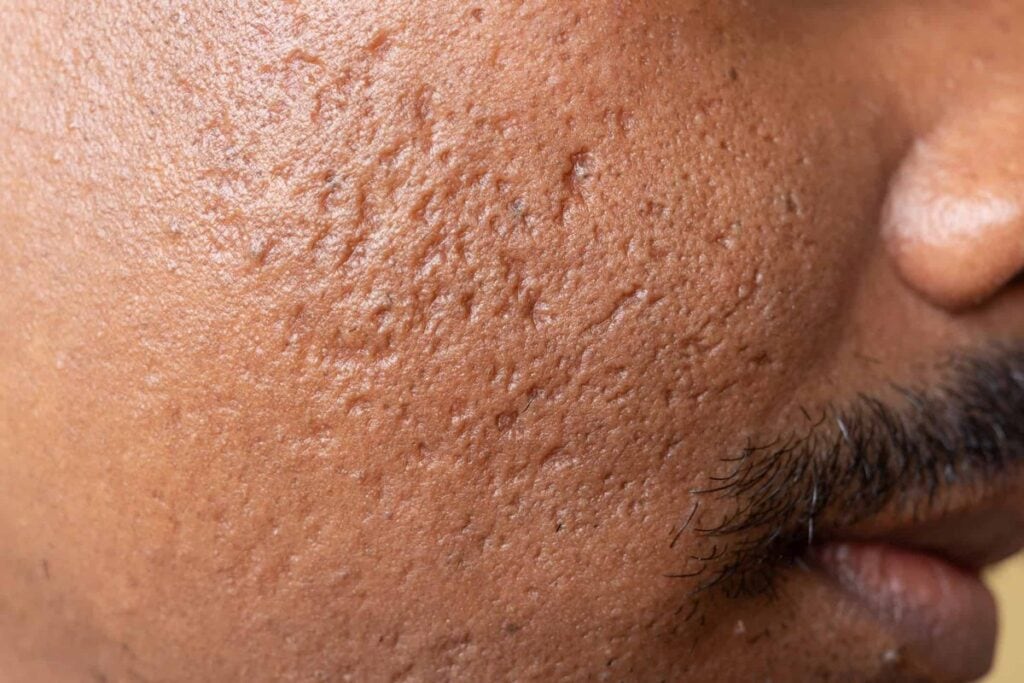
The pitted scars you have learned to angle away from the camera finally have their match. CO2 laser resurfacing is an intensive resurfacing treatment on Wimpole Street, reaching deep scarring, etched lines and sun damage, with five to seven days of planned downtime and results that last years. From £300.
per treatment
Resurfacing used to remove the entire surface of the skin, with dramatic results and weeks of healing. A fractional ablative laser is far cleverer: it vaporises a grid of microscopic columns, and the untreated skin left between them heals the surface in a week rather than a month.
Skin
The treatment for pitted scarring, because it reaches the depth the scar sits at.

Skin
Sun damage that has roughened the surface, removed rather than faded.

Skin
Rough texture smoothed from deeper down than any exfoliant reaches.

Face
Deeply etched lines around the mouth, where resurfacing does more than filling.
A CO2 laser removes a narrow column of tissue and heats the tissue around it.
How deep those columns go is what separates treating surface texture from treating a pitted scar.
A CO2 laser removes a narrow column of tissue and heats the tissue around it. How deep those columns go is what separates treating surface texture from treating a pitted scar.
Pitted scarring sits deep below the surface, and CO2 reaches it, column by column.
Deeply etched lines around the mouth are softened by resurfacing and the collagen that follows.
Fine etched lines around the eyes respond to a shallower, denser setting.
Roughened surface texture and sun damage across the face need density rather than depth.
Pitted scarring is a structural defect below the surface, so it needs depth. Fewer, deeper columns reach the scar tissue and the skin fills it from below as it heals.

Settings are chosen for your skin and for what is being treated. The depths shown are illustrative, not device settings.
Skin type assessment, a conversation about the result you are hoping for, and a patch test where your skin type calls for one. Pre-treatment skincare is often recommended for four weeks beforehand.
What you feel or see A conversation and a small test patch.
What to do Start the recommended skincare and keep out of the sun.
Skin type assessment, a conversation about the result you are hoping for, and a patch test where your skin type calls for one. Pre-treatment skincare is often recommended for four weeks beforehand.
What you feel or see A conversation and a small test patch.
What to do Start the recommended skincare and keep out of the sun.
Strong topical anaesthetic for forty five to sixty minutes, then thirty minutes to an hour of treatment depending on area. Cold air is used throughout for comfort. Depth and density are set to your skin and your problem rather than a default: deep pitted scarring needs depth, while fine surface texture and sun damage need density at a shallower setting.
What you feel or see Heat and prickling, with the smell of treatment in the air, which is normal.
What to do Plan a week at home or working quietly.
Intense redness, swelling and heat, similar to strong sunburn. The skin feels tight and looks bronzed as micro-crusts form.
What you feel or see Hot, tight and swollen.
What to do Occlusive balm, and a few days makeup-free.
The bronzed layer flakes away to reveal pink new skin. Most patients are presentable with mineral makeup around day seven.
What you feel or see Pink, fresh skin.
What to do Let it flake away on its own.
Skin looks smoother and brighter within a fortnight.
What you feel or see Fresher texture.
What to do Daily SPF from here on, to protect your new skin.
Pinkness fades over several weeks. The meaningful change in scarring and texture appears from four weeks and improves steadily to the six month point.
What you feel or see Scarring and texture soften month by month.
What to do Photographs at the same angle and lighting each month.
The final result is assessed at three months. Acne scarring typically shows a visible improvement for most people over one to three sessions. If a further session is planned, it is decided now.
What you feel or see A clear view of what one session has achieved.
What to do Decide on a second session with your clinician.
Results last for years, because new collagen is genuinely new tissue, and daily SPF keeps it that way.
What you feel or see Lasting change.
What to do Daily SPF.
Skin type assessment, a conversation about the result you are hoping for, and a patch test where your skin type calls for one. Pre-treatment skincare is often recommended for four weeks beforehand.
Strong topical anaesthetic for forty five to sixty minutes, then thirty minutes to an hour of treatment depending on area. Cold air is used throughout for comfort. Depth and density are set to your skin and your problem rather than a default: deep pitted scarring needs depth, while fine surface texture and sun damage need density at a shallower setting.
Intense redness, swelling and heat, similar to strong sunburn. The skin feels tight and looks bronzed as micro-crusts form.
The bronzed layer flakes away to reveal pink new skin. Most patients are presentable with mineral makeup around day seven.
Skin looks smoother and brighter within a fortnight.
Pinkness fades over several weeks. The meaningful change in scarring and texture appears from four weeks and improves steadily to the six month point.
The final result is assessed at three months. Acne scarring typically shows a visible improvement for most people over one to three sessions. If a further session is planned, it is decided now.
Results last for years, because new collagen is genuinely new tissue, and daily SPF keeps it that way.
Your final result is reviewed at three months.
Acne scarring typically shows a visible improvement for most people over one to three sessions.
Every patient is assessed by a qualified clinician, a doctor, nurse or other qualified practitioner, before anything is booked.

Lead Practitioner
Award-winning aesthetic nurse practitioner with more than twenty years of specialist NHS nursing and over a decade in advanced aesthetic medicine. Qualified independent prescriber and the clinic’s CQC registered manager.

Doctor
MBChB, BSc (Hons), with First-Class degrees in Physiological Sciences and in Medicine and Surgery, and extensive NHS experience across medical and surgical specialties. Trained with DermaMedical.

Senior Aesthetician
Known to patients as SK. Over thirteen years’ experience and more than fifty aesthetic lasers and devices, having worked at five-star clinics across London.
The right choice depends on your skin and what you are treating; a consultation settles it.
| CO2 laserFractional ablative laser | Morpheus8Radiofrequency and micro pins | MicroneedlingSkinPen, micro pins only | |
|---|---|---|---|
| How it works | Removes tissue from the surface down | Radiofrequency to 4mm without ablating | Micro pins only |
| Best for | Sharply cratered scars and surface sun damage | Soft rolling scars, laxity and darker skin | Shallow scarring and texture |
| Downtime | 5 to 7 days | 2 to 3 days of redness | A day |
| Darker skin | Real pigmentation risk, patch tested | Safe, does not target pigment | Safe, does not target pigment |
| See pricing | Explore Morpheus8 | Explore microneedling |
On darker skin we frequently recommend Morpheus8 or microneedling instead, since neither targets pigment.
Downtime5 to 7 days
Course1 to 3 sessions
ResultsFrom 4 weeks, building to 6 months
Your plan and the number of sessions are agreed at your consultation, before anything is booked.
A fractional ablative laser that vaporises microscopic columns of damaged skin, leaving healthy skin between them to drive fast healing. It resurfaces and stimulates collagen at the same time. The heat surrounding each column also stimulates collagen across the following months. The device lives at our Wimpole Street clinic, so treatment runs there only.
For anyone whose pitted scarring has stayed put through courses of microneedling and peels. Those treatments work nearer the surface, and CO2 reaches the depth where your scarring sits.
It asks for a week of your diary in return, as the one treatment on our list with downtime you plan around. If a week away is hard to find, your clinician can map out a course of something gentler.
£300 for a small scarred area, £450 for a medium area and £600 for a full face at our Marylebone clinic. Most patients having acne scarring treated need one to three sessions.
Five to seven days. Days one to three are red, swollen and hot. Days four to seven the bronzed layer flakes away. Most patients are presentable with mineral makeup around day seven.
Topical anaesthetic goes on for forty five to sixty minutes and cold air is used throughout. You feel heat and prickling. Afterwards it feels like strong sunburn for two to three days.
One to three for acne scarring depending on depth. Sun damage and texture often respond to one. We plan the course at consultation rather than session by session.
Brighter, smoother skin within two weeks. The real change in scarring and texture builds from four weeks to six months as collagen forms.
Years. New collagen is genuine new tissue, and daily SPF afterwards keeps it looking its best.
Your clinician assesses your skin type carefully and patch tests where needed. For Fitzpatrick IV to VI we frequently recommend Morpheus8 or microneedling, since neither targets pigment.
CO2 removes tissue from the surface down and is better for sharply cratered scars and surface sun damage. Morpheus8 delivers radiofrequency to 4mm without ablating and is better for soft rolling scars, laxity and darker skin. Both are at our Wimpole Street clinic.
Occlusive balm, hands off the flaking skin, makeup once the flaking finishes, a week off exercise, and shade plus mineral SPF for at least three months.
You can, with careful sun protection. Autumn and winter are the ideal booking window, because new skin heals best out of the sun.
Every plan starts with a conversation and a close look at your skin, so the treatment you book is the one that suits you.
Tell us what you’d like to achieve. Regents Park Aesthetics will be in touch within one working day to arrange your consultation.

