





Body
Hair Loss & Thinning
Where the evidence is strongest, while the follicles are still active.
Explore skin
Care starts with your skin, not a treatment name.
Explore injectables
A medical consultation and an individual approach.
Explore face & body
Explore options for contour, muscle and firmness.
Explore concerns
You do not need to know the treatment. Tell us your concern.

Explore skin
Care starts with your skin, not a treatment name.
Explore injectables
A medical consultation and an individual approach.
Explore face & body
Explore options for contour, muscle and firmness.
Explore concerns
You do not need to know the treatment. Tell us your concern.

Platelet-rich plasma, skin and hair
It often starts with a glance at your parting under the bathroom light. At Wimpole Street your own platelets are concentrated and returned to exactly where they are needed: a well-established clinic treatment for early hair thinning, and a beautifully natural boost for skin.
per treatment
Platelets carry growth factors, the signalling proteins the body uses to trigger repair after injury. Blood is drawn from your arm and spun to concentrate the platelet-rich fraction, which is then injected where it is needed, prompting that repair response in tissue that would love a boost: a thinning parting, tired skin, the delicate under-eye.
Body
Where the evidence is strongest, while the follicles are still active.

Face
It suits the under-eye well because it adds no volume at all.
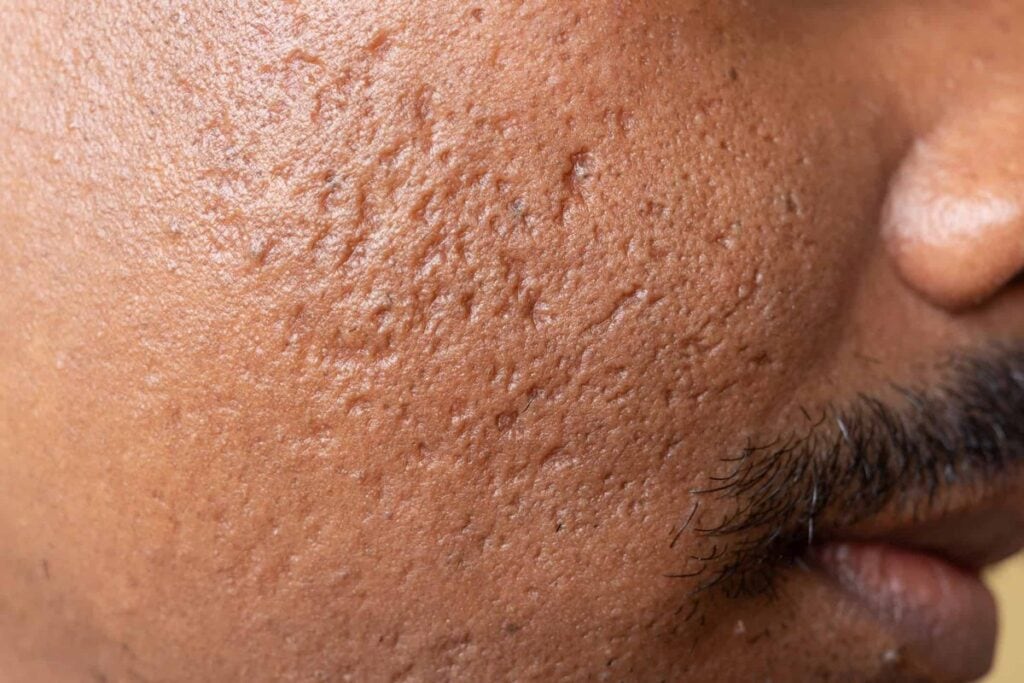
Skin
Commonly combined with microneedling, absorbed through the channels as they are made.

Skin
Skin quality improved using nothing synthetic, which many patients love.


After three treatments. Regen Lab shows this case on its acne scar page, where RegenPRP is used alongside other treatments, so this result is not from PRP alone. Case by Dr Abbas Al T., Australia. Image courtesy of Regen Lab. Individual results may vary.
Hair is where the evidence is strongest, while the follicles are still active.
For skin, it improves quality and under-eye texture where a lighter touch suits best.
Hair is where the evidence is strongest, while the follicles are still active. For skin, it improves quality and under-eye texture where a lighter touch suits best.

The parting that has begun to widen. Reduced shedding is usually the first sign, at six to eight weeks; visible density change takes three to six months.
Temples that have begun to recede are treated in the same session.

Under-eye texture improved with nothing synthetic, where a lighter touch suits best.
Injected across the face for skin quality, the treatment the press named the vampire facial.
Blood draw, ten minutes in the centrifuge, then injections with topical anaesthetic for the scalp. Mild tenderness for a day. Three to four monthly sessions, then maintenance every four to six months.
For hair, we ask for recent blood tests before starting, so your scalp treatment works on the full picture.
What you feel or see A conversation and a blood test.
What to do Bring recent blood results if you have them.
For hair, we ask for recent blood tests before starting, so your scalp treatment works on the full picture.
What you feel or see A conversation and a blood test.
What to do Bring recent blood results if you have them.
A standard sample from the arm, then ten minutes in the centrifuge. Injections across the scalp or the treatment area, with topical anaesthetic for the scalp, which is sensitive.
What you feel or see A needle in the arm, then small injections; the scalp is numbed first.
What to do Wash your hair the following day rather than the same evening.
Mild tenderness and occasional small bumps for a day.
What you feel or see Tender to the touch, briefly.
What to do Carry on as normal.
The response is cumulative, which is why the protocol is three to four monthly sessions rather than one.
What you feel or see Each session repeats the same visit.
What to do Keep to the monthly rhythm.
The growth factors bind to receptors on the cells in the treated tissue and prompt them to behave as they would during healing: increased blood supply, new collagen, and in the scalp a longer active growth phase for follicles that had shortened it. Reduced shedding is usually the first sign, at six to eight weeks. For skin, improvement in texture and tone appears from about six weeks and builds across the course.
What you feel or see Less hair in the brush; skin texture improving.
What to do Photographs with identical parting, lighting and distance, so you can see every change.
Visible density change takes three to six months, because hair grows slowly and follicles must cycle.
What you feel or see A fuller parting and temples where follicles were still alive.
What to do Compare the photographs.
Hair treatment is ongoing care, because the underlying cause continues. Most patients maintain every four to six months, and your clinician plans how it fits with any other care.
What you feel or see Density held with maintenance.
What to do Your clinician reviews your plan at each visit.
For hair, we ask for recent blood tests before starting, so your scalp treatment works on the full picture.
A standard sample from the arm, then ten minutes in the centrifuge. Injections across the scalp or the treatment area, with topical anaesthetic for the scalp, which is sensitive.
Mild tenderness and occasional small bumps for a day.
The response is cumulative, which is why the protocol is three to four monthly sessions rather than one.
The growth factors bind to receptors on the cells in the treated tissue and prompt them to behave as they would during healing: increased blood supply, new collagen, and in the scalp a longer active growth phase for follicles that had shortened it. Reduced shedding is usually the first sign, at six to eight weeks. For skin, improvement in texture and tone appears from about six weeks and builds across the course.
Visible density change takes three to six months, because hair grows slowly and follicles must cycle.
Hair treatment is ongoing care, because the underlying cause continues. Most patients maintain every four to six months, and your clinician plans how it fits with any other care.
Visible density change takes three to six months.
Hair grows slowly and follicles must cycle, which is why the protocol is three to four monthly sessions rather than one.
Every patient is assessed by a qualified clinician, a doctor, nurse or other qualified practitioner, before anything is booked.

Lead Practitioner
Award-winning aesthetic nurse practitioner with more than twenty years of specialist NHS nursing and over a decade in advanced aesthetic medicine. Qualified independent prescriber and the clinic’s CQC registered manager.

Doctor
MBChB, BSc (Hons), with First-Class degrees in Physiological Sciences and in Medicine and Surgery, and extensive NHS experience across medical and surgical specialties. Trained with DermaMedical.

Aesthetic Doctor
MBBS, MRCS. An Imperial College London graduate and Member of the Royal College of Surgeons, with surgical training in plastic surgery and ENT head and neck surgery. In aesthetic practice since 2017.
Some treatments do the same job a different way. Others do a different job alongside it. The right combination depends on your skin and what you are treating; a consultation settles it.
| PRPPlatelet-rich plasma | PRFPlatelet-rich fibrin | |
|---|---|---|
| Preparation | Spun faster and used as a liquid | Spun gently without anticoagulant, forming a fibrin matrix |
| Growth factors released over | Hours | Days |
| See pricing | See pricing |
| PolynucleotidesCellular repair | Other hair-loss careArranged separately | |
|---|---|---|
| What it adds | Improves the scalp environment for early thinning | Your clinician explains how they fit together |
| How | Part of the full combination protocol | Discussed at consultation |
| Explore polynucleotides |
Your clinician chooses between PRP and PRF. Under the eyes, polynucleotides are sometimes the better choice and we will compare them at consultation.
Course3 to 4 monthly sessions
Results from3 months
Downtime24 hours
Your plan and the number of sessions are agreed at your consultation, before anything is booked.
For early to moderate thinning while follicles are still active, yes, with good clinical evidence. It works best on areas that are thinning, so earlier is better.
Two groups, mostly. People whose hair has begun to thin and who have noticed the parting widening or the temples receding, and people who want skin improved using nothing synthetic.
Thinning responds while the follicles are still active, and your clinician maps exactly which areas will respond before you commit to a course. Because it uses your own blood, nothing foreign is introduced.
That is the name the press gave PRP injected across the face for skin quality. It is the same treatment.
£499 for hair loss, £399 combined with microneedling, £599 for the full combination protocol with a booster or polynucleotides.
Three to four monthly, then maintenance every four to six months. Hair treatment is ongoing care that holds the result.
Reduced shedding at six to eight weeks. Visible density change takes three to six months.
PRP is spun faster and used as a liquid. PRF is spun gently without anticoagulant, forming a fibrin matrix that releases growth factors over days rather than hours. Your clinician chooses based on the area.
The scalp is sensitive and topical anaesthetic is used. Most patients describe pressure and brief stinging. The whole appointment is around forty five minutes including the draw and spin.
Mild tenderness and occasional small bumps for a day.
Thinning can have more than one driver, and checking first means your treatment targets the full picture.
It uses your own blood, prepared with sterile technique and careful handling in a medical clinic on Wimpole Street. Your clinician runs through your medical history at the consultation.
Yes. Your clinician explains how they fit together.
Yes, and it suits that area well because it adds no volume. Polynucleotides are sometimes the better choice and we will compare them at consultation.
Every plan starts with a conversation and a close look at your skin and scalp, so the treatment you book is the one that suits you.
Tell us what you’d like to achieve. Regents Park Aesthetics will be in touch within one working day to arrange your consultation.